STARGAZING SESSION IN CALIRAYA , LAGUNA |
||
November 13-14, 2004 by Allen Yu |
||
The heavens and earth's most desperate observers finally collide this evening, to capped off perhaps the last important observing session of this year, under the dark skies of Caliraya, Quezon. This year has been soaked with rain and clouds, compensated only by the appearance of five comets (I wonder how astrologers will handle this!), which might as well be a hard year to beat for comet afficiandos. Tonight is my 10" truss Dobsonian-Newtonian telescope debut. Finally, it will drink starlight from the provincial breeze. Joel Munoz has convinced me to convert it from the traditional tube design, so it can be portable, and I'm glad I listened to him. Also, tonight it will test my deep-sky potential, and I consider just observing a few of the favorites, not to rush in the numbers, so I can dig deeper in each objects details. My sketches, however refined, contain the most important features noted. I admitted to Orly Andico that I was not prepared to show him my initial impressions which I can be proud of, the sketches needed a little bit of doctoring under normal light condition to make it look better. Astronomical sketches, be it deep-sky and planetary, always go through this process, the same with imagers. The important thing is for one to maintain the raw data, polish it, but not add or subtract any feature aside from the ones honestly observed. I have also omitted most surrounding stars as it took so much time plotting them on the logpage. M31. Andromeda Galaxy is one of the easiest galaxy to I am not surprised at its size though my 10" reflector with a 22m Panoptic. Okay Orly, now I've done the math, the effective field of view should be a little bit more than 1 degree. To be frank, I was not obsessed with math like before, as I've learned to accept that beauty lies in the beholder, not numbers , naks! :) true enough, the full extent didn't seem to fit in entirely as the galaxy's edge touched my eyepiece's edge. Nevertheless, the most interesting part was the very distinct dust lane (a dark lane running along the galaxy's northwest edge). Notice that the southern part of the glow blends slowly to the darkness of background space, while the dust lane abruptly stops the glow in the northwest. The galaxy's signature feature was a strong central glow, with a secondary glow in less-ideal skies. But tonight, the entire thing was simply long, almost featureless. I can make out the entire shape and size, nothing further. My red light must be the one doing so much damage to my eyes, as sketching and observing is like mixing oil and water. At times when I took a lengthly break to return observing M31, new features appear, but upon sketching, they disappear! How frustrating! M33. Shooting back from the Andromeda galaxy pass Beta Andromedae, and at approximately the same distance is M33, the notorious big but not so easy galaxy residing in Triangulum. Reminiscing the view done more than a year ago in Buso-buso, M33 now packs a punch through the 10" and under darker skies. Easy through my 9x50 finder as a distinct blob, M33, under close scrutiny and dark adapted eye (you only use one eye peeking through the eyepiece!), two of its main spiral arms can be confirmed through averted vision, and stronger core packed with some stars (my comments), and the whole thing is enveloped in a fuzziness which seemed to extend to fill the whole field of view of my 22mm Panoptic, observed Dr. Jose Aguilar. My sketch of M33 disagrees the general impression of Stephen James O'Meara's in book The Messier Objectsand Guy Mackie's in December 2004 issue of Sky and Telescope's Targets. It seemed my "S" shape arms are illusory. However, more research follows and two guys vindicated my false claim: Lord Rosse and Roger Clark. Rosse reported it as full of knots with two S-shaped curves crossing in the center (maybe the stars embedded within are the knots). I am happy to report a lot of details from a seemingly featureless blob. Cheers! M42. The Orion Nebula continues to amaze me. God Also, my efforts are limited. My impression here did not match close to that of O'Meara's. I need the entire night to sketch this whole thing, and a very dark adapted eye. Tonight, I only had about 20 minutes. This is the struggle of an urban dweller! NGC 2024. I had high hopes of visiting an old but elusive friend, the Flame Nebula beside Alnitak. Also for the first time, the entire tree and its branches were almost easy with direct vision. Surprises, surprises. I was also making a bit of untidiness to the south of Alnitak, but never got something really exciting. Was hoping to have a glimpse of the reflection nebula where the Horsehead resides! However, the sky was not perfect either, there are many times when the dark sky suddenly loses contrast, perhaps of some thin haze, or my frequent opening of red light to sketch my object of desire hampering so much of my bionic eyes. Making my 10" as a truss system to make it transportable to a dark site is one of my best thing I've ever done in my 8 year hobby. The results are very encouraging and rewarding. M65, M66, and NGC 3628. The rush before dawn breaks! Just as Van Helsing rushes to slay the Count, I wanted to shoots three birds in one stone! Spotting Leo was stupidly a near-miss, due to my tired eyes and brain, I have to voice out asking James for the "reverse question mark" asterism. Twilight is at hand, and every minute delay is truly damaging. Alas, a difficult sketch was made on my moisture-soaked logbook to capped off perhaps the last important dark-sky observation of this year 2004. My impression of the field should not disappoint observers alike, I have done researches with legendary observer's books and my observation has been consistent. I need these verification to understand that we do improve in our field. Cheers! Another two comets tucked on our belts. For some ALPers, this could be the sole reason for joining this yearender trip. And to think that the Machholz comet gave me the ultimate convenience, and not to mention rarity, as the 2nd bright comet since Hyakutake, to be placed almost opposite the Sun (midnight that means)! Easy does it, the constellations Lepus and Columba were reintroduced to me, which I cared less to think that it's a southern hemisphere territory, are just plainly visible high in this November night! Maccholz was spotted with the gracious help of Dante Cruz, who custom-printed some maps for that very easy find, also for the second comet just before the break of dawn, Linear 2003 K4, which Dante's map says its 25 degree to the right of Jupiter. True enough, I found it chicken feed locating it without even bothering to identify the constellation Corvus. Hehehe.
|
||
|
For Comments jkty@astroleaguephils.org |
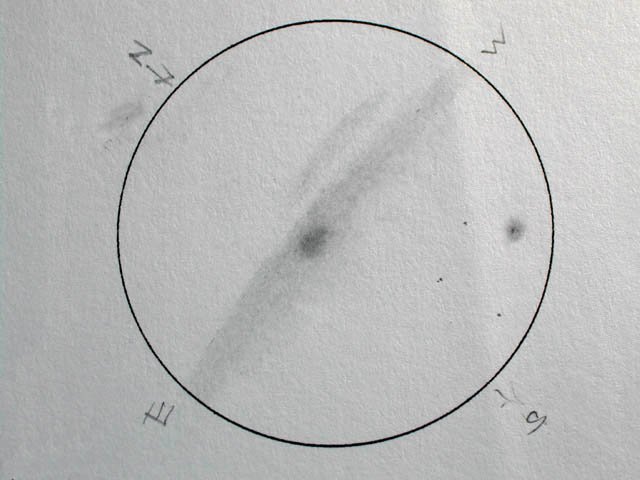 spot yet difficult to observe and sketch. Easy, really, as it was
visible through my eyeglasses (thanks, Doctora Chat!) and I can even make out its real
size while pointing it to Mr. Orly Andico. No glasses though, no galaxy.
That's how simple it is :)
spot yet difficult to observe and sketch. Easy, really, as it was
visible through my eyeglasses (thanks, Doctora Chat!) and I can even make out its real
size while pointing it to Mr. Orly Andico. No glasses though, no galaxy.
That's how simple it is :)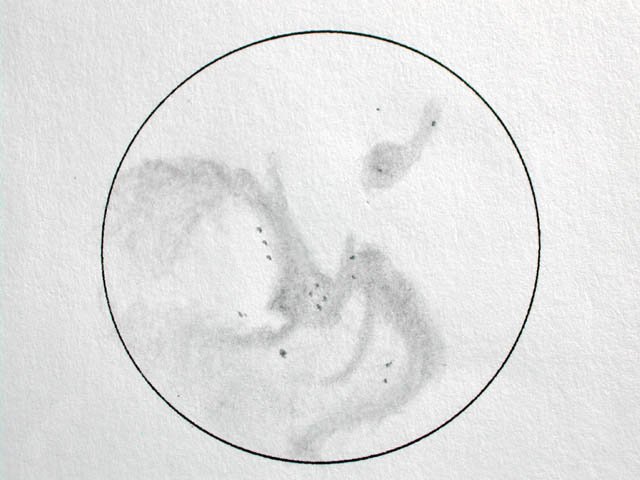 bless my opportunity to see an old friend in a different light. It
seemed M42 always reveal one new thing and another. The view at 63X 22mm Panoptic is
almost frighteningly huge! The bat's wings revealed some more branches,
and for the first time (I don't recall seeing this before), the wings extend to close a
giant loop laced with nebulosity of different tones and knots. Too bad my sketch did
not capture this whole loop, owing to the limited field of view my Panoptic has to
offer! Ha! The thing is I have to include M43 so the entire M42 could not fit
into my circle, but hey! I even missed the Running Man NGC 1973 didn't I?
bless my opportunity to see an old friend in a different light. It
seemed M42 always reveal one new thing and another. The view at 63X 22mm Panoptic is
almost frighteningly huge! The bat's wings revealed some more branches,
and for the first time (I don't recall seeing this before), the wings extend to close a
giant loop laced with nebulosity of different tones and knots. Too bad my sketch did
not capture this whole loop, owing to the limited field of view my Panoptic has to
offer! Ha! The thing is I have to include M43 so the entire M42 could not fit
into my circle, but hey! I even missed the Running Man NGC 1973 didn't I?