STARGAZING SESSION IN CALIRAYA , LAGUNA |
||
November 13-14, 2004 by Orly Andico |
||
Lalai and I joined James, Allen, and a group of other ALP members at Hilltop Resort in Caliraya, Laguna for what was supposed to be a two-night observing session (but turned out to be just one night due to uncooperative weather). We arrived at the site at around 1900, but not before having to contend with obstinate immovable cattle, and their large deposits of digested grass. After dinner, we all drove to the observing site, which was basically a dew-laden field, and set up. Or, tried to set up. Due to the mud, traction was very poor and more than one car got stuck and had to be pushed. There were biting ants everywhere, too.
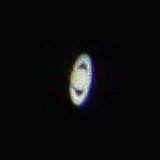
Cows, cow doo, mud, ants, and rain -- it was all worth it though. Although fast-moving clouds would occasionally obscure sections of the sky, the sky condition was the best I've ever seen: very little skyglow not more than 10 degrees above the horizon, and uncountable stars within Orion. The first object I looked at was of course M42, which is the easiest to find. Compared to last All Souls in Pangasinan (where the moon was more than half-full) I could see a lot of detail within the "bat wing" -- dark twisting filaments and tendrils, the Trapezium tiny but unmistakable at 35X, and M43. The bluish-green color was very evident. I also had a few looks at M45, the Pleiades (after which both the Japanese car and telescope are named, "Subaru") which are a fine binocular target. The sisters wouldn't fit in my field of view though (which is about 1.85 degrees). The Pleiades looked much nicer in binoculars. I had got a glimpse of M31, the Andromeda Galaxy, from outside the dining hall, with 10x50 binoculars. I had a chance for another look at it at the site. Surprisingly, it didn't look "8 inches better" in the 10" telescope. Probably it's my being a beginner at observing. When I took a better look, I also saw M32 and M110, the satellite galaxies. I failed to spot the prominent dark lane, though. After seeing M31 with binoculars, I realized that I had seen it before, almost two years ago, from the PAGASA observatory in UP. At that time, Lalai and I were using my ETX60 and I thought I was imagining things. I only saw the core from UP; 60mm of aperture and lots of skyglow didn't exactly help so I wasn't sure if there was anything there, but seeing M31 again confirmed my prior observation. Next object was M1, the Crab Nebula supernova remnant. Allen helped me out with this. Unlike M42 or M31, M1 is dim and nondescript. Turns out almost all deep-sky objects are dim and nondescript. It actually looked like an egg-shaped, unresolved globular cluster through the 10". I also tried splitting Rigel. At 100X (36mm homemade Erfle and 3X Meade barlow) the split was really wide. The companion is a lot dimmer and noticeably bluish compared to Rigel, which is whiter. Some of the other guys were looking at the Beehive Cluster, M44, and the Double Cluster in Perseus, NGC 869 and NGC 884, so I decided to have a go at them too. The Double Cluster was easy to find, and looked very nice. The Beehive was just another open cluster, nothing like M45. Personally I think my favorite open cluster must be the Jewel Box in Crux. The contrasting star colors were quite a sight last summer. Oh well.. next year. Again with Allen's help, I was able to catch a glimpse of M33, the large face-on spiral in Triangulum. At this point, I was constantly migrating between Allen's 10" dobsonian and my own. I didn't see any spiral structure though, in either scope. It looked like a scrambled egg in a really dark room. One thing consistent I noticed was that images were visibly brighter in Allen's scope. I suspect that's mostly due to his fantastic 35mm Panoptic. My homemade 36mm Erfle had an almost identical field, more eye relief, but much more prone to blackout, stars at about 60% from the center were not points, there was noticeable field curvature, and due to the lack of coatings on the Surplus Shed lenses, much less light throughput. It also cost about fifty times less. I was joking around with some of the other ALP members than my entire scope cost less than Allen's Panoptic, which is not a major exaggeration. After midnight, Saturn had risen enough for me to have more than a few good looks at it. For the first time, I saw some of the Saturnian satellites. Actually I saw three, arranged about 120 degrees apart from each other and quite far from the ringed planet. I was quite surprised because I was accustomed to Jupiter's close-orbiting, tidally-locked satellites. The largest, greenish satellite was definitely Titan, and according to Starry Night the other two were Rhea and Dione. Just for kicks, I tried doing some single-shot afocal photos of Saturn with a Minolta DImage F100 point and shoot. I didn't even have an afocal adapter, so I just held the camera up to the eyepiece (homemade Erfle and 3X Meade barlow, for 100X). The results were so encouraging for a first-timer that I took a whole series of shots, hoping to stack them. And here are my results:
I also did a "crazy high power" stunt on Saturn: 6.5mm GTO Plossl and 3X barlow, for about 586X. The sky couldn't support it, and neither could my mirror. No further detail could be glimpsed, but Saturn filled the (disappointingly narrow) field. And my creaky mechanics made observation nearly impossible. One thing I've decided though is that I hate Plossls (so the feeling I have for my 9mm and 25mm Kellners cannot be described). The field is annoyingly narrow, and the eye relief nonexistent. I found myself vastly preferring my homemade Erfle. Of course the GTO Plossls aren't exactly high-class eyepieces, but they're supposed to be at least acceptable, as Plossls go. Actually I think I'll be happy with something like the 30mm GSO SuperView and something for high power. But they have to have large apparent fields. Even 65 degree like my homemade eyepiece is perfect for me. But not the 40 to 50 degrees of Kellners or Plossls. I can't justify buying a Panoptic, because firstly, so many other parts of my scope need to be improved first, and secondly, considering how much time I put in this hobby, blowing nearly $400 on an eyepiece really seems impractical. I also had a look at Comet Machholz (C/2004 Q2) in Allen's scope, somewhere below Lepus. I couldn't find it in my own, due to my not knowing it's position, and my very poor finder. It looked like a small globular cluster (maybe like M4 in binoculars) but with a faint tail. Last summer's comet C/2002 T7 was definitely more impressive, even in a smaller scope. Lalai suddenly remembered wanting to see the Horsehead Nebula (Barnard 33) and Flame Nebula (NGC2024). So we went to Allen again (who must've been suffering from all the questions). The Flame is supposed to be easy to find, very close to Zeta Orionis (Alnitak). And he said "it was right there" but I could not see it through his scope. At best I saw a faint shapeless mottling in the center of the field. In my scope, absolutely nothing. Since the Flame is a prerequisite to even glimpsing B33, I decided not to try. Around 0200 Lalai and I went to sleep in the car. I set my alarm for 0345 so I could have a look at Jupiter. I actually saw five satellites, first time that's ever happened, as well as the incongruous star HIP61791 hanging around in the same field. The best view was at 100X (36mm Erfle and 3X barlow). I could distinguish about four cloud bands. Pretty bad for a 10" but the seeing was not good. I tried doing the afocal trick again, but I couldn't get any surface detail on the planet. No photos here. I also had a last look at Orion, which was close to the zenith, and finally was rewarded with a view of the Running Man Nebula, NGC1977. I am semi-sure I saw the legs and body of the running man. By 0400 or so, Venus had climbed into the sky as well. I tried a look at that: horrific, eight diffraction spikes due to my not-quite-aligned Del Monte can turned spider. Something I will definitely refine in the near future. The disk was readily apparent even at 35X but no surface features. Venus was almost overwhelmingly bright. I later took some hand-held, 1/4 second shots (with just the camera) to capture the glow from the still-hidden Sun, plus the two planets:
I also tried to look for M81 and M82 near the Big Dipper's bowl, but again was unsuccessful. By this time it was getting light, so I had another nap in the car till the other guys were done. Then we had our obligatory group photos, went back to the resort for breakfast, then another nap. |
||
|
For Comments jkty@astroleaguephils.org |
 By 2130 everyone had settled down. I think I set the record for fastest
setup: took me around two minutes to haul my dobsonian tube out of the back seat, get the
base from the trunk, plunk it down on the nearest flat surface, and put the tube on top.
The door springs worked loose though. And mechanically my scope was the worst by far on
the field. I'm already planning a complete rebuild, based on the many ideas I got from
Allen's very well made dobsonian, which looks like something Singmaster might have
made.
By 2130 everyone had settled down. I think I set the record for fastest
setup: took me around two minutes to haul my dobsonian tube out of the back seat, get the
base from the trunk, plunk it down on the nearest flat surface, and put the tube on top.
The door springs worked loose though. And mechanically my scope was the worst by far on
the field. I'm already planning a complete rebuild, based on the many ideas I got from
Allen's very well made dobsonian, which looks like something Singmaster might have
made.